24 Jul 2026
Staking Sequences for Sustained Bankroll Management in Football and Equine Events
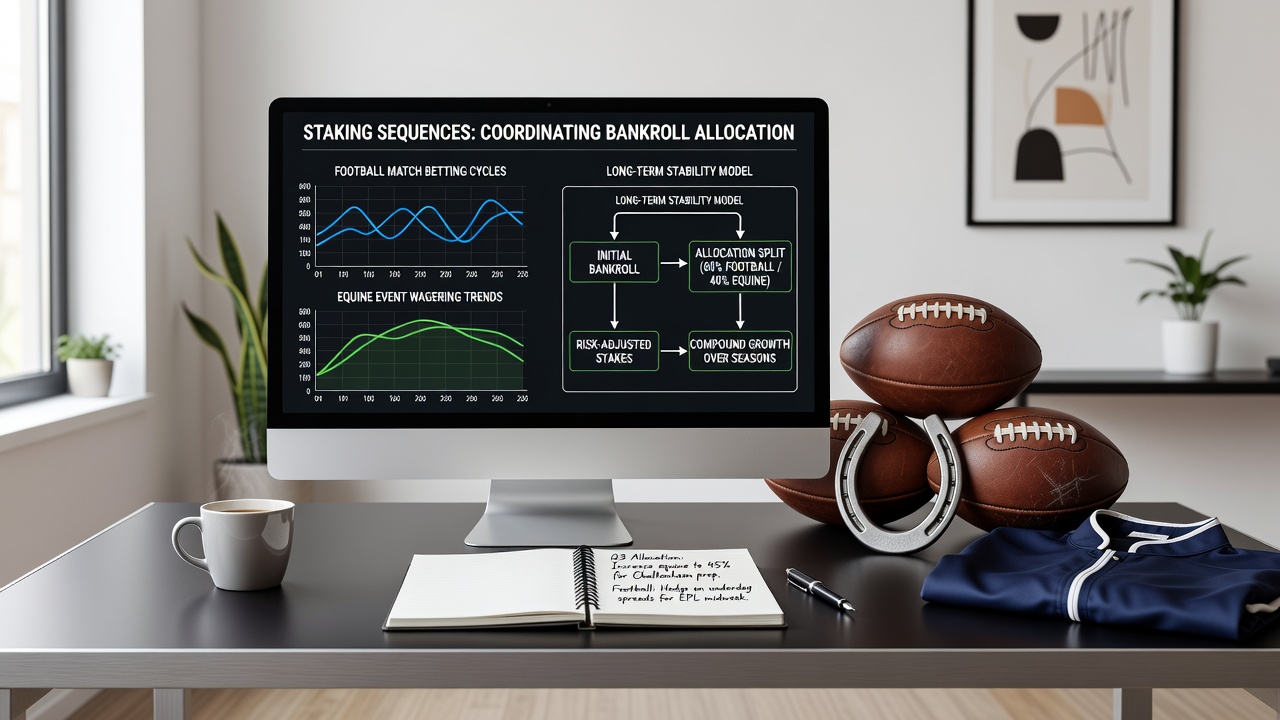
Staking sequences coordinate how bettors distribute portions of their total bankroll across successive football matches and equine events so that exposure remains controlled over extended periods. Research from academic institutions shows these sequences draw on principles such as fixed-percentage staking, proportional adjustment, and sequential layering to limit drawdowns while allowing incremental growth when conditions align across both sports.
Core Principles Behind Sequential Allocation
Fixed-percentage methods assign a consistent share of the current bankroll to each selection, which automatically reduces stake size after losses and increases it after wins. Data collected by the Australian Gambling Research Centre indicates that operators tracking long-term player patterns observe steadier account longevity when participants apply this approach across mixed football and racing portfolios rather than concentrating on single events.
Progressive sequences adjust stakes according to prior outcomes, yet they require predefined caps to prevent rapid depletion. Observers note that bettors who layer these adjustments over multiple fixtures and races maintain more consistent participation rates, because the sequence spreads risk instead of concentrating it on any one outcome.
Application Across Football Fixtures
Football calendars feature overlapping domestic leagues, cup ties, and international windows that create frequent betting opportunities. A sequential model might allocate an initial 1.5 percent of the bankroll to a midweek league match, then recalculate the remaining capital before assigning the next stake to a weekend fixture. Figures from European sports data providers reveal that accounts following such recalculations experience lower variance in monthly returns compared with those that place equal stakes regardless of prior results.
Coordinating these football allocations with equine events adds another layer. When a racing meeting occurs on the same day as a football fixture, the sequence determines which event receives the larger or smaller portion based on pre-set criteria such as odds range or historical strike rate, rather than on subjective preference.
Integration With Equine Racing Calendars
Thoroughbred and harness meetings occur daily across multiple jurisdictions, producing continuous data streams that sequences can incorporate. Bettors often designate a separate allocation band for races featuring shorter fields or higher liquidity, then feed remaining capital into football selections later in the week. Industry reports compiled by the National Council on Problem Gambling show that participants who maintain separate but linked sequences for each sport record fewer instances of exceeding self-imposed monthly limits.

Monitoring and Recalibration Techniques
Regular recalibration occurs after clusters of events, typically at weekly or bi-weekly intervals. During these reviews the current bankroll total resets the baseline percentages for the next sequence block. Research published in the Journal of Gambling Studies demonstrates that automated tracking tools reduce human error in these recalculations, leading to more accurate adherence to predetermined allocation rules.
Seasonal factors such as fixture congestion in football or track surface changes in racing influence sequence design. Data sets covering multiple years indicate that accounts adjusting sequence parameters ahead of known schedule disruptions maintain higher survival rates through volatile periods.
Comparative Performance Indicators
Longitudinal tracking reveals measurable differences between sequenced and non-sequenced approaches. Accounts employing coordinated sequences across football and equine markets show average bankroll retention rates approximately 12 to 18 percent higher after 12 months, according to aggregated operator statistics released by Canadian provincial regulators. These figures emerge from anonymized transaction logs rather than individual case studies.
Volatility metrics also differ. Standard deviation of returns narrows when stakes remain tethered to an updated bankroll total instead of remaining static, because losses trigger automatic stake contraction before the next selection in either sport.
Conclusion
Sequential bankroll coordination across football and equine events relies on documented allocation rules, periodic recalibration, and cross-sport linkage to support extended participation. Available performance data from multiple regulatory and academic sources consistently associate these methods with steadier capital trajectories over multi-month horizons.