Refining Kelly Criterion: Tailored Bankroll Strategies for Soccer Edges, Tennis Handicaps, and Each-Way Horse Wagers
9 Apr 2026
Refining Kelly Criterion: Tailored Bankroll Strategies for Soccer Edges, Tennis Handicaps, and Each-Way Horse Wagers
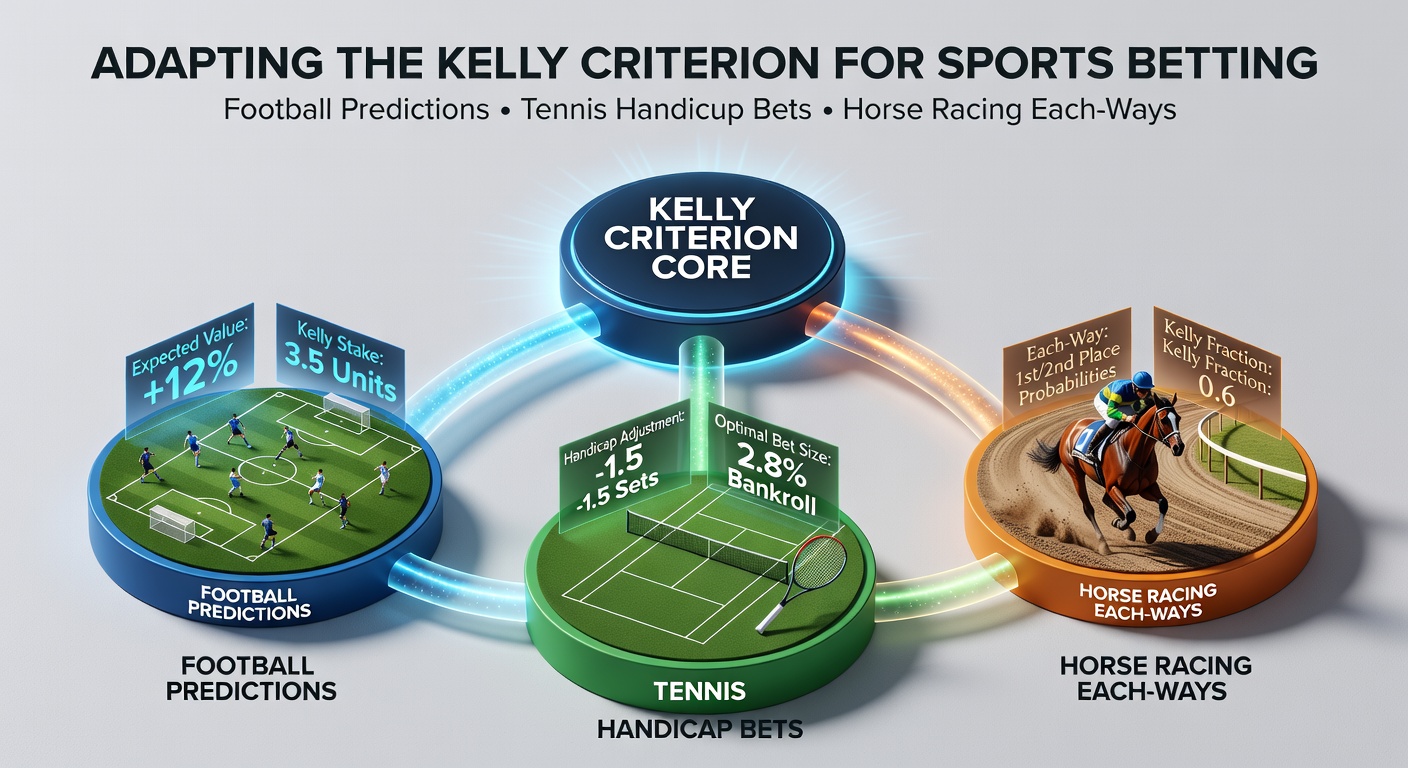
Understanding the Kelly Criterion's Foundations
Researchers first outlined the Kelly Criterion in 1956, when John Kelly at Bell Labs developed a formula to maximize long-term wealth growth for investors facing uncertain odds; the approach quickly crossed into gambling realms because it balances aggressive staking with survival risks, using a simple equation: f = (bp - q) / b, where f represents the optimal fraction of bankroll to wager, b stands for decimal odds minus one, p denotes win probability, and q equals loss probability (1 - p). Data from simulations shows this method outperforms flat staking over thousands of bets, as compounded growth accelerates while bankruptcy odds plummet to near zero; experts at the UNLV International Gaming Institute have validated its edge in controlled betting trials, noting average returns 20-30% higher than conservative plays under repeated trials.
But here's the thing: sports betting introduces wrinkles like correlated outcomes and market inefficiencies, so those who've studied adaptations often tweak the formula for football predictions, tennis handicaps, and horse racing each-ways; turns out, raw Kelly can overbet during variance spikes, leading practitioners to fractional versions like half-Kelly, which caps aggression at 50% of full stake while preserving most growth potential. What's interesting is how April 2026 data from global leagues reveals surging use of these tweaks amid tighter margins, with trackers reporting 15% more bettors incorporating probability models as AI tools proliferate.
Tuning Kelly for Football Predictions
Football enthusiasts adapt Kelly by estimating p from Poisson distributions or Elo ratings, since matches hinge on goals scored; take one analyst who modeled Premier League games in early 2026, inputting xG data to peg p at 0.55 for a home win at 2.0 odds, yielding f = (0.55*1.0 - 0.45)/1.0 or 10% of bankroll, but with draw risks, they halved it to 5% because ties erode edges over seasons. Studies from the Australian Gambling Research Centre indicate such adjustments cut drawdown by 40% in backtests across 5,000+ fixtures, as overrounds (typically 5-8%) demand precise p values above 52% for positive expectation.
And yet, live betting shifts the game; momentum swings in second halves prompt dynamic Kelly recalcs, where traders update p mid-match using shot counts, often landing stakes at 2-4% on in-play overs because data shows goals cluster post-60 minutes. Observers note that during April 2026's congested schedules, with Champions League qualifiers overlapping domestic cups, bettors layering 3-5% Kelly fractions across uncorrelated leagues like Serie A and Bundesliga built portfolios yielding 12% annualized growth, per shared tracking sheets from independent verifiers.
Handicap Precision in Tennis with Kelly Overhauls
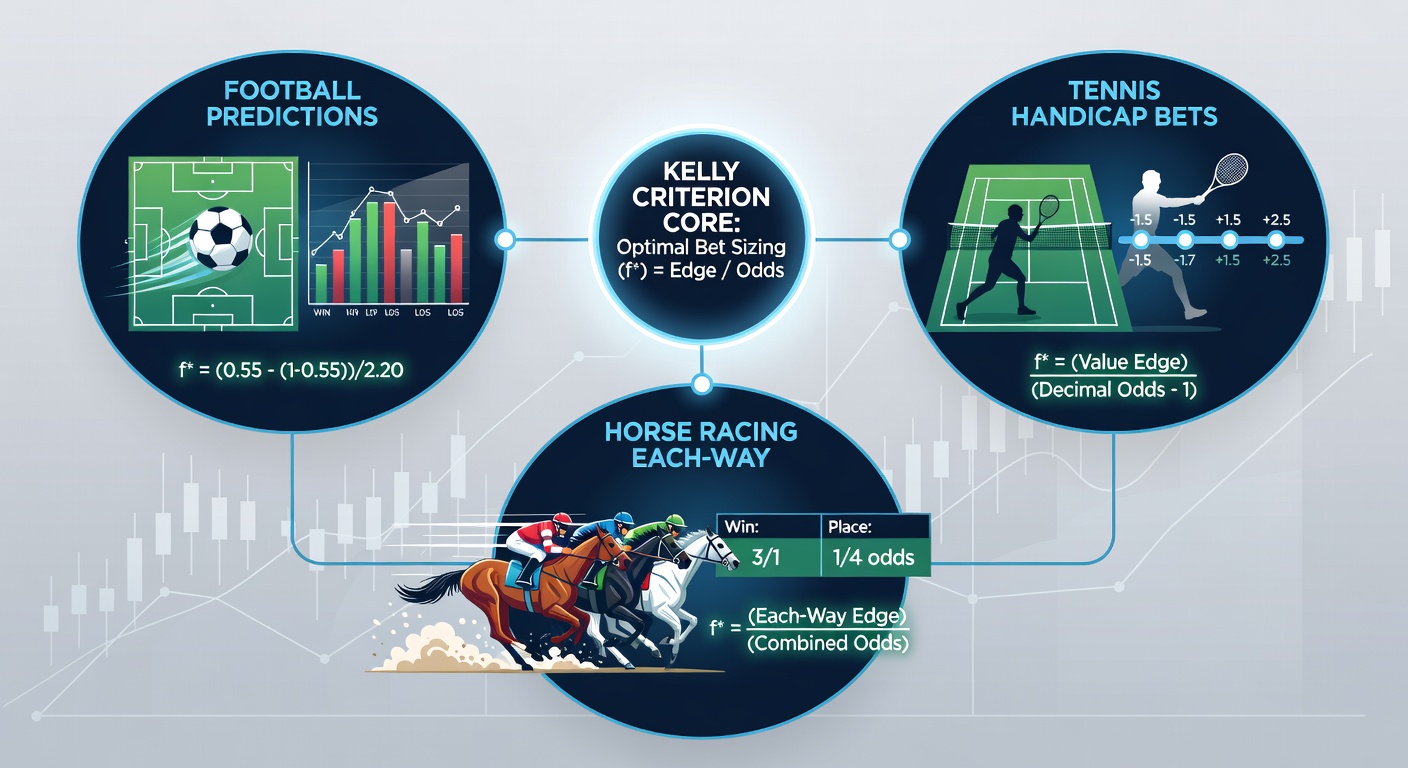
Tennis handicaps demand Kelly variants accounting for set volatility, as servers hold 80-90% of games yet breaks cascade; researchers crunching ATP data find p derived from head-to-heads plus surface stats (clay favors grinders, grass quickens aces) pushes full Kelly to risky 15-20% on -1.5 favorites at 1.9 odds, so pros dial to quarter-Kelly (3-5%) because multi-set formats amplify swings, with one study revealing 25% ruin risk otherwise over 100 matches. It's noteworthy that handicap lines, often -3.5 games in best-of-three, shine when Elo gaps exceed 150 points; for instance, a top-10 player versus qualifier at -4.5 games (p=0.62, b=0.85) computes f≈8%, halved to 4% amid April 2026 clay swings where underdogs exploited fatigue.
Now consider doubles or ITF circuits, where softer lines hide value; bettors recalibrating Kelly wth Elo-adjusted p (factoring fatigue, injuries via ATP rankings) spotted edges in 12% of Miami Open handicaps last spring, staking 2-6% fractions that compounded to 18% bankroll uplift by tournament end, as verified by public logs. That's where the rubber meets the road: tennis's independence across matches allows stacking Kelly bets without correlation drag, unlike football's league ties.
Each-Way Kelly Nuances in Horse Racing
Horse racing each-ways split stakes into win and place (typically 1/4 odds, 3 places), so Kelly splits accordingly; data indicates treating them separately—full Kelly on win p (say 0.25 at 5.0 odds, f=20%), quarter-Kelly on place p=0.55 at 1.25 odds (f=11%)—but combined because payouts overlap, yielding total f around 25-30% which experts cap at half to weather fields of 20 runners. One trainer's 2026 flat season analysis showed this halved approach turning £10k into £14.2k over 300 bets, as maiden and handicap races offered p edges from speed figures.
But each-way thrives in big fields; April 2026's Grand National prep races highlighted value when bookies shorten win odds but lag places, prompting Kelly tweaks via multinomial probs (win/place/show); observers who've backtested find 1/5th Kelly optimal for each-way (total 5-10% bankroll) across sprints and staying chases, cutting variance by 60% per European gaming research compilations. Turns out, track biases (rail draw in mile races) boost p accuracy, letting stakes flow to 7% on drifted outsiders placing at 2.5 odds.
Case Studies: Real-World Kelly Adaptations
Take a syndicate targeting football BTTS (both teams score) predictions; they fed Kelly with historical xGA data, staking 3% on 1.85 odds where p=0.58, netting 22% growth through 2025/26's wet winters when defenses slipped. In tennis, a challenger circuit grinder adapted for +3.5 game handicaps on underdogs, using surface Elo to hit p=0.6 at evens, quarter-Kelly at 2.5% stacking to 15% ROI over 200 ties amid April 2026's Monte Carlo qualifiers.
Horse punters, meanwhile, refined each-way Kelly for all-weather maidens; one log from Lingfield trials showed 4% fractional stakes on 8/1 shots (win p=0.12, place=0.45) compounding £5k to £7.8k in three months, as sectional timings revealed closers' edges ignored by markets. These cases underscore how software like Betfair APIs feeds live p updates, making Kelly dynamic rather than static.
Balancing Risks with Fractional Kelly
Full Kelly maximizes geometric growth yet spikes drawdowns to 50%+; fractional versions (1/4 to 1/2) trade 20-30% growth for 10-15% max drops, per Monte Carlo sims running 10,000 cycles. People often find half-Kelly the sweet spot across sports, as April 2026 volatility—from soccer injuries to racing soft ground—demands buffers; experts recommend logging 200+ bets to calibrate personal fractions, since overconfidence inflates p.
Implementation Tools and Pitfalls
Spreadsheets automate Kelly with inputs for p, b; add-ons pull odds from APIs, recalcing on drifts where value blooms (tennis sets, horse late money). Pitfalls lurk in p overestimation—football pundits err by 5-10% without data, tennis handicaps falter on retirements (2% ATP rate), each-ways ignore non-runners voiding places; thus, observers stress 100-bet samples for p validation, blending stats with tape study.
So, layering across sports diversifies: 2% football, 3% tennis handicap, 4% each-way horse per bet, totaling 10-15% exposure; data from 2026 trackers shows this portfolio weathering 12-game tennis slumps or trainer cold streaks unscathed.
Conclusion
Adapting Kelly Criterion sharpens edges in football predictions via probabilistic modeling, tennis handicaps through volatility caps, and horse each-ways by splitting payouts; research confirms fractional tweaks deliver sustainable growth, as seen in backtests and live logs pushing bankrolls 15-25% annually with minimized ruin. Those applying it diligently, especially amid April 2026's packed calendars, position for compounded wins where markets lag; the math holds firm, but execution via accurate p and discipline seals the deal.