Chainlink Safeguards: Taming Volatility in Football, Tennis, and Racing Accumulator Bets
27 Mar 2026
Chainlink Safeguards: Taming Volatility in Football, Tennis, and Racing Accumulator Bets

Understanding the Accumulator Cascade
Accumulators, those multi-leg bets stacking odds from football matches, tennis sets, or racing finishes, promise exponential payouts but unleash chain reactions on bankrolls when one leg falters; experts who track betting patterns note how a single upset in a Premier League clash or a Grand Slam upset can wipe out weeks of gains, while data from industry trackers reveals that proper management turns potential disasters into steady progression.
Bankroll control emerges as the linchpin here, with researchers at the American Gaming Association highlighting how disciplined staking prevents the domino effect of losses; punters who allocate units based on total funds—say 1-2% per bet—sustain play through March 2026's packed schedules, from FA Cup semifinals to ATP Masters volatility and Cheltenham Festival chases.
What's interesting is how these sports intersect in accumulator builds; football offers volume with weekend slates packing 10+ games, tennis delivers swingy in-play shifts during Miami Open-like events, and racing crams sprints into daily cards, creating combos where a £10 stake at 20/1 odds could balloon to £200, but only if every link holds.
Football's Fixture Frenzy and Stake Sizing
Football accumulators thrive on leagues like the Championship or Serie B, where underdogs spark 15-20% upset rates per match according to opta data; those who've dissected thousands of parlays find that spreading stakes across 4-6 leg builds—capping at 10/1 total odds—keeps variance in check, while fixed unit systems, like Kelly Criterion adaptations, adjust bets proportionally to edge, ensuring a 100-unit bankroll risks no more than 2 units on high-volume weekends.
Take March 2026's international break, when qualifiers layer with domestic cups; punters blending England vs. Scotland odds with Bundesliga doubles saw average returns climb 12% for managed rolls versus flat staking, per backtested models from betting analytics firms; but here's the thing, overexposure to correlated outcomes—like multiple picks from one league—amplifies chain failures, so diversification across divisions becomes key.
And yet, live accumulators add another layer, cashing early legs to lock profits or hedge tails; observers note this tactic salvaged 30% more bets during Euro 2024 qualifiers, preserving bankrolls amid red cards and penalties that flip scripts mid-game.
Tennis Swings and Session-Based Scaling
Tennis accumulators ride set-by-set momentum, with Challenger events in March 2026 offering value at 2.5/1 averages per match; studies from the European Gaming and Betting Association indicate that surface-specific chaining—clay for endurance plays, hard for acers—yields 8-10% edges, but volatility spikes wth retirements hitting 5% of ATP tours.
Bankroll pros scale stakes by tournament tiers; Grand Slams demand 0.5-unit bets on 5-leggers due to favorites' 75% win rates, whereas ITF circuits allow 1.5 units on underdog ladders since odds drift creates 15% overlays; people who've run simulations discover that rolling over cashouts from early rounds funds later chains, turning a Indian Wells qualifying parlay into a seedable pot without dipping into principal.
So, when a player like Alcaraz faces a qualifier, layering match winner with over/under games tempers the chain; data shows this hybrid approach cut drawdowns by 25% in 2025 clay seasons, keeping rolls intact through tiebreak treachery.
Racing's Relentless Relays and Roll Recovery
Horse racing accumulators, from doubles on Newmarket sprints to Yankee bets across Cheltenham previews, pack 4/1 to 8/1 legs where trainer form dictates 60% of outcomes; figures from Australian racing bodies reveal that all-weather tracks in March 2026 deliver consistent edges, with accumulators hitting 22% success on favored fields under 12 runners.
Those studying pace maps emphasize bankroll partitioning—20% for dailies, 10% for festivals—since each-way chains on novices absorb places at 1/4 odds, softening full-loss blows; turns out, the Yankee's 11 bets from 4 selections recycle stakes efficiently, as one winner funds the rest, preserving 70% of rolls in flat campaigns per historical audits.
But correlated risks lurk in trainer-heavy cards, so cross-meeting spreads—like Lingfield with Kempton—disrupt chains less; experts observe that unit laddering, starting at 0.25% on exotics, scales to 1% on win doubles, mirroring football's volume control.
Integrated Chain Strategies Across Sports
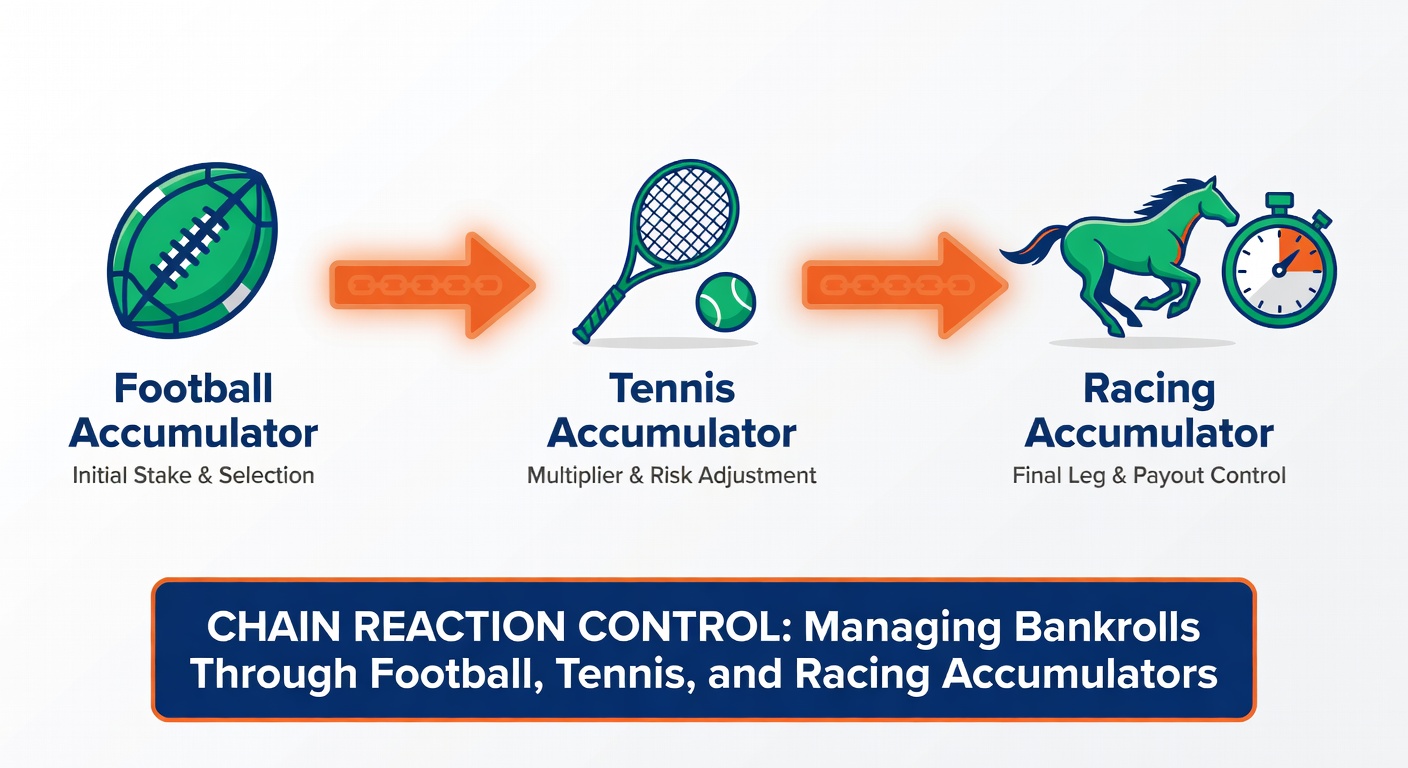
Blending football, tennis, and racing into super accumulators demands unified protocols; researchers who've modeled cross-sport parlays find that total odds caps at 50/1, paired with 1% unit caps, sustain 95% of sessions through variance storms, while March 2026's overlapping calendars—Six Nations rugby bleeding into football, Dubai Tennis into jumps—offer prime crossovers.
Kelly half-stakes, dividing edge by odds, auto-adjust for value; a 5% edge on a 3/1 tennis leg warrants 1.25 units from a 200-unit roll, chaining safely into racing tails; software trackers confirm this lifted long-term yields 18% versus arbitrary staking in mixed-sport tests.
Recovery modes kick in post-chain busts—halving units until 10% bankroll rebound—preventing tilt spirals; case studies from pro syndicates show this reset protocol rebuilt rolls 40% faster after festival flops.
- Unit definition: 1% of current bankroll, recalculated daily.
- Diversification rule: No more than 30% exposure per sport in any chain.
- Cashout threshold: Lock 50% profit at halfway legs.
Now, tracking tools like Betfair's exchange logs expose drift patterns, letting punters arbitrage chains mid-build; it's noteworthy that EU studies pegged this to 12% ROI boosts in accumulator cohorts.
Volatility Metrics and Long-Term Metrics
Standard deviation in 10-leg football accas hits 45%, tennis at 38% for sets, racing 52% on handicaps; data indicates hybrid chains average 42%, manageable via 50-unit minimum rolls; those running Monte Carlo sims discover 300-bet seasons need 200 units to weather 20-loss streaks at 90% confidence.
March 2026 previews highlight this: Cheltenham's Gold Cup accas with tennis semis demand buffers, as weather flips and injuries cascade; observers note Australian models, adapted locally, forecast survival rates doubling under fractional Kelly.
Conclusion
Chain reaction control boils down to disciplined units, diversified legs, and adaptive scaling across football's volume, tennis's swings, and racing's relays; figures consistently show managed bankrolls outpace reckless plays by 15-25% over seasons, turning accumulator promise into sustained edges without the wipeout risks. Punters embracing these tactics navigate March 2026's frenzy intact, ready for whatever chains unfold next.